
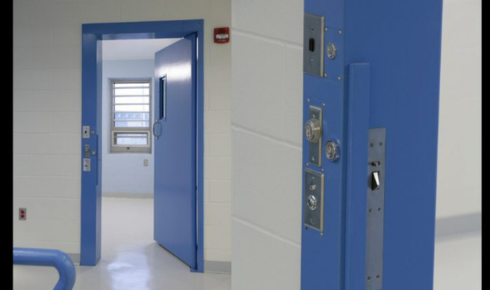
Security doors in detention environments carry responsibility far beyond basic access control. Every layer, weld, and component is engineered to handle constant stress, attempted tampering, and long service life under demanding conditions. Understanding the materials behind high-security detention center doors explains why experienced Cornerstone detention equipment contractors focus so heavily on material selection from the very start.
Heavy-gauge Steel Plates Built to Resist Cutting and Impact
Heavy-gauge steel plates form the primary barrier in detention center doors. These plates are selected for thickness and density that make cutting tools ineffective and slow down any attempt at forced entry. The added mass also absorbs blunt-force impact, reducing deformation under repeated strikes.
Beyond strength, plate consistency matters. Uniform thickness across the door surface prevents weak points that could be exploited. Cornerstone detention center doors often rely on precisely specified steel gauges to ensure the entire door performs as a single protective unit.
Reinforced Steel Frames Welded for Continuous Strength
A door is only as strong as its frame. Reinforced steel frames are welded rather than mechanically fastened to eliminate seams that could loosen over time. Continuous welds distribute stress evenly and prevent separation at joints.
Frame geometry also plays a role. Proper reinforcement resists twisting under load, especially during forced closure or impact attempts. Cornerstone security detention equipment contractor teams understand that frame integrity is just as critical as the door slab itself.
Ballistic-rated Steel Cores for High-risk Control Points
Certain areas require added protection against projectile threats. Ballistic-rated steel cores are used in doors located at control points, transport corridors, or high-risk zones. These cores are engineered to stop or slow ballistic impact while maintaining structural stability. Ballistic steel adds complexity to fabrication. Weight distribution, hinge support, and locking alignment must all be adjusted. Cornerstone prison supply manufacturers account for these factors to ensure ballistic protection does not compromise door operation.
Hardened Hinge Pins Made to Prevent Tampering
Hinges are frequent targets for tampering. Hardened hinge pins are designed to resist cutting, grinding, and removal. These pins are often concealed or shielded to limit direct access.
Material hardness is carefully balanced. Pins must withstand constant movement without brittleness. In Cornerstone detention center doors, hinge assemblies are selected to provide long-term reliability while resisting intentional damage.
Stainless Steel Skins for Corrosion-prone Environments
Moisture, cleaning chemicals, and environmental exposure accelerate corrosion. Stainless steel skins protect door surfaces in areas prone to humidity or frequent washdowns. These skins maintain appearance while preserving structural layers beneath.
Stainless steel also simplifies maintenance. Smooth surfaces resist buildup and are easier to sanitize. Cornerstone detention equipment contractors often specify stainless skins for longevity in harsh operating environments.
Composite Infill Panels Adding Rigidity Without Excess Weight
Composite infill panels enhance rigidity without adding unnecessary weight. These panels are layered within the door structure to stiffen large surfaces and reduce vibration during impact or slamming.
Weight control matters for hinges, frames, and automated systems. Composite materials allow doors to remain strong while staying within operational limits. Cornerstone prison supply manufacturers use these infills to balance strength and performance.
Anti-pry Edge Channels Formed into the Door Structure
Door edges are common leverage points. Anti-pry edge channels are formed directly into the door structure to block tool insertion. These channels redirect force back into the door rather than allowing separation.
Edge reinforcement also protects locking areas from side attacks. The integration of these channels requires precision forming during fabrication. Cornerstone security detention equipment contractor teams rely on these features to reduce long-term vulnerability.
Solid Steel Lock Pockets Protecting Internal Mechanisms
Locking systems must remain protected even under attack. Solid steel lock pockets surround internal mechanisms, shielding them from drilling, prying, or impact. These pockets act as armor for the most critical components of the door.
Designing lock pockets involves more than thickness. Proper alignment ensures smooth operation while maintaining protection. Cornerstone detention center doors incorporate these pockets to preserve security without sacrificing reliability.
Fire-rated Steel Layers Meeting Life Safety Requirements
Security cannot come at the expense of life safety. Fire-rated steel layers are incorporated to meet code requirements for fire resistance. These layers slow heat transfer and maintain door integrity during fire exposure. Fire-rated construction requires tested assemblies rather than individual materials alone. Steel layers work in combination with insulation and seals. Cornerstone detention equipment contractors ensure these systems meet safety standards while maintaining high-security performance. Material selection defines how detention center doors perform over decades of use. Cornerstone delivers integrated security solutions built to meet strict operational and safety standards across a wide range of institutional needs.